
Among the under servants at Sans Souci was an old black man, born in Africa, who professed to be a witch doctor. He had first come to Milot in chains to be tried by the King for the offense of practicing his trade without proper regard for the Kingdom's laws "governing the medical profession." But Christophe had acquitted him and he had stayed on at the palace.
At daybreak this man was brought to the King's bedchamber.
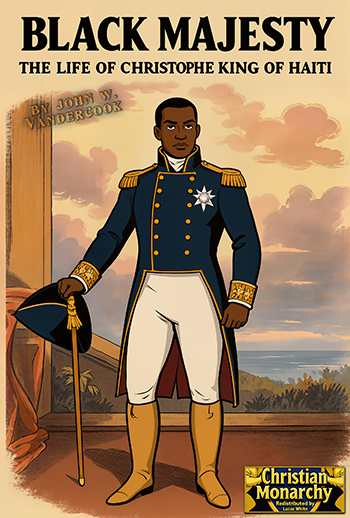
For two hours the witch doctor, aided by a valet, massaged Henry's body with a mixture of red pepper and raw rum, a liniment held in great esteem in the old slave days. At nine o'clock they dressed him in his most splendid blue-and-white-and-gold uniform and at ten his four bodyguards propped him in a throne-like chair and carried him down the stairs and out on to the main terrace at the palace's western end.
Below, filling the narrow valley of Milot and stretching away into the humid distance, were the assembled regiments of the army of Haiti, their rich and vivid uniforms glinting brightly in the morning sun. Certain companies were missing, but it was a lack no one spoke of.
Every eye was turned toward the palace. Half the army saw the King's chair being carried to its place on the terrace. Five thousand blacks could hear Christophe's booming, roaring voice break the silence:
"Bring me my horse," he called.
It was the first sound he had uttered that day.
The white horse, fully caparisoned, was waiting behind a wall. In a complete and breathless quiet a groom led it across the terrace toward Henry's throne.
At sight of it a vast shouting smashed the silence. With a single voice the army cheered, "Vive le Roi! Vive Vhomme Christophe!" Down the valley thousands of hats were flung into the air. The hoarse, gigantic shouting beat against the mountains and rolled back in thundering echoes. Drummers in the ranks pounded wildly, fiercely, on their drums.
The horse came to a stand ten feet from the throne. The four bodyguards turned toward the King. He shook his head and swept them away with his arm. He twitched off the robe that covered his lap.
Dr. Stewart, standing in the crowd, pulled at his clean-shaven chin and stared.
Christophe looked straight before him. He breathed deep. The cheering suddenly ceased while the echoes faded down the valley. Christophe stood erect.
In five powerful, headlong strides he reached the white horse. One hand went to its mane, the other to the saddle. He bent a little to leap up. But while the court and army looked on, King Christophe slowly, slowly, like an empty bag, slumped down till he lay under the horse's feet with his arms outstretched and his face against the earth. The strength so miraculously summoned for the instant had gone out of him.
Rain had fallen during the night. When Stewart, the Queen, little Vastey, and Dupuy picked him up, his uniform was smeared with mud. Dry sobs were shaking him.
When they set him back in the throne the soldiers below cheered again, but this time the sound was scattered and half-hearted. The Queen bit her lips. The gaping courtiers near by noted with astonishment that sour, silent Dr. Stewart, was smiling with a queer proud smile and that tears ran unashamed down his furrowed cheeks.
The King gave an order. A page ran down the stairs to where the first company of soldiers stood by the singing fountain that fell over the bright blue wall.
The parade began.
As each platoon passed the throne where Christophe sat the men broke into spontaneous cheers: "Vive le Roi! Vive Vvhomme Christophe!"
A little beyond him a clerk sat at a table and gave each man as he passed a gift from the King of four gourdes of money.
Then, because they had reached the far end of the west terrace, the line of marching men turned around a high garden wall that hid Christophe from their sight.
The review lasted several hours. Christophe sat upright and kept his right hand rigidly in salute. But when a third of the procession had passed him, two sorts of cheering sounded faintly in the valley.
As the soldiers passed before him they called, "Vive UVhomme Christophe'; as they passed around the corner of the wall out of sight of him, they broke ranks, and, all unconscious of the contrast, shouted, "4 bas le Roi! Vive Vindépendance!"
Each company had been touched by the revolution. Duke Richard and the generals associated with him had given word that there was to be no more work, that the Kingdom would become part of the Republic, and that all men at last were to be gloriously free. "The tyranny is ended," was the cry.
They had come to the review drawn by a lingering dread and a lingering love for their King. But the master had crumpled into the mud, and though, when his eyes were on them, they cheered and stayed in stiff parade, once out of his sight they were quit of him.
At last the tail of the procession, still meek but not cheering, passed and Christophe turned his head to find that the nobles, the generals, the servants, the gentlemen and ladies in waiting who had stood behind his throne in the morning, had quietly slipped away. Except for a few who stood close to him he was alone.
The valet and the witch doctor; elderly, wise Prévost, Count of Limonade and Secretary of State; Dupuy; Baron Vastey; three old, erect black generals; the Scotch physician; the fat Prince Royal Victor-Henry; the young negro princesses, Athénaire and Améthiste; and Marie-Louise, his beloved, gentle, simple Queen, were there beside him. A stone's-throw away was the palace of Sans Souci—queerly named—its doorways empty and its leaded windows swinging wide. Evidently the last of its servants and sentries had gone away.
The King lifted his hands helplessly to them and they carried him through the echoing, silent palace up to his balcony.
They brought him his battered brass telescope. He sent one of the generals down the royal road to find out the progress of the rebellion and bring the report back.
Athénaire and Améthiste, his daughters, one twenty and the other twenty-two, sat on the ground and laid their cheeks against his knees. He sent the others away.
He saw the solitary general, who somewhere had found a rich, brocaded banner, ride proudly down the wide white road toward Cap Henry. The old man went as if a great army followed close behind him. 'Two hours later, in the twilight, he came back. A rebel sniper had shot off his cocked hat and he had lost his banner. He was still alone.
Christophe sent his daughters away and asked for Dr. Stewart. The sun sank below the faraway rim of the sea and the night rode swiftly up the hills. Soon the valley of Milot was dark and murmurous. The sunlight touched the mountain peaks and then was gone.
The Scotch doctor sat on a stiff chair beside the King. They had been friends so long, talk was superfluous.
Once Henry whispered: "Toussaint, the Tiger, and I... . We dreamt so much and we have done so little."
Again, with a certain rich pride in his tone, he said: "To be great, Duncan, is to be lonely. To be magnificent is to have men hate you."
The sky was red with the reflection of flames. The King's chateaux in the Plaine du Nord were on fire. Through the brass telescope one could see little dancing shadows pass before the pyres of flames. Now and then an isolated shot, a sound of distant cheering, and a brief mad rumble on a tom-tom drum came up to them. Christophe cleared his throat.
"Duncan, they will be here soon now. You must go. There are still horses in the stables, I think. Take whatever you can find that's worth anything, then go by back trails to the Cap. You will be safe with the English consul... . Good-by."
"Henry," said Dr. Stewart, "don't be a Goddamned fool."
He stood up. "I am going to send Marie-Louise and the children to you, but I will be over the hall if you want me."
They shook hands.
The Queen and the King's three children came to him. He then sent for Vastey and Dupuy. He said good-by to them all, gave, in something of his old tone of command, orders that the two men were to take his family at once to Cap Henry and put them under the protection of English friends there. He gave Marie-Louise the papers that entitled her to the fortune Sir Home Popham had deposited in the Bank of England for her. Then he kissed them and sent them away.
When they had gone he called his valet and asked him to bring a bowl of water.
While the man stood by he slowly washed his hands and dried them on a damask napkin. Then he sent the man away.
But the servant stayed outside the door of the King's bedchamber and watched through the keyhole.
He saw Christophe, after a long, quiet minute, throw himself off his chair and with clutching fingers drag himself across the room to a closet. He saw him reach up and turn the knob, saw him pull down a snow-white satin gown, roll himself into it, and then, like some stricken animal, drag himself horribly across the floor to his bed and lift himself on to it.
From where he lay Christophe could look down the valley. It was not empty now. It was filled with a shouting, running mob of men carrying torches.
The King took something from a little cabinet by his bedside. While the trembling valet still peered hypnotized through the keyhole watching him, he fell back and lay still. A tall clock in the corridor ticked regularly.
Running feet sounded on the stairways. The first of the looting rebels were already in the palace.
A great crash of broken glass was heard.
"They are breaking even the mirrors that have imaged me!" said the King aloud, and his voice was broken.
He clenched his right fist and raised his left hand, which held a pistol, to his temple.
A shot reverberated, followed by sudden quiet. The King was dead. He had put a golden bullet, molded long ago, through his brain.
Marie-Louise and the others had disobeyed the King's command. They gave gold and jewels to the looters to bribe them not to mutilate his body. They tied sheets to two poles, laid Christophe on the improvised stretcher, and at midnight the Queen, the two Princesses, and little, fierce old Vastey left Sans Souci by a secret door and started up the long, dark trail that leads to Henry's Citadel.
The dead King was a heavy load; doubly heavy for one old man, an old negress, and two young girls, all heartbroken.
But all that night they labored up the trail, while Stewart and Dupuy and the three generals rode with Prince Victor toward Cap Henry.
Dawn found the cortege on the last half mile of the winding trail that snakes over bare ground. just under the gray walls of the fortress. As the night mists rose and broke against the prow the sentries on the wall saw them. No news had come to them up there. The sudden shout resounded, "Ie Roi est mort!' 'The sentries left their posts, the laborers and soldiers who were forming lines for the morning parade took up the shout, ran down the corridors behind the cannon, and burst out the lower door.
A handful of officers and men tried vainly to stem the tide. But when the Queen and Vastey with their burden ended the climb and came under the portals of the fortress door the Citadel was empty and the hillsides were alive with running, laughing men on their way to join the rebels in the valley.
Slowly, panting and weak from exhaustion, they staggered through the galleries and came out in the sudden brightness of the central court.
The morning was cool. Green parrots flew cawing overhead,
The few faithful soldiers and officers who had stayed behind came to attention. Willing hands reached out and took the heavy stretcher.
Vastey and the governor of the Citadel entered into a quick whispered consultation. "There was no time."
' The Queen and the Princesses must be rushed to safety.
A pit of new mixed builders' lime lay open in the center of the parade ground. Vastey and the governor lifted the stretcher high over their heads and with a tremendous effort turned it over,
The King's bedy pitched from its winding sheet, turned in the air, and with a sullen splash fell into the lime. It sank down and the white corrosive lipped in on it like a hungry mouth. The bystanders caught their breaths. The surface of the lime was still and smooth. But above it, through it, thrust up the King's right hand and his bare black wrist. The hand was clenched. It seemed in death to be still masterful, still strong.
"There was no time." They left him there.
In the empty, gigantic fortress on the mountain-top the King's hand threatened the stillness and the morning sky.
The revolutionists, fearful lest the royal line go on, murdered Prince Victor-Henry. They let Marie-Louise and the daughters go away. Améthiste died eleven years later, and her sister lived for eight years after her. Marie-Louise, the Queen, outlived her lover and her King by more than thirty years. They had found comfort in religion and all are buried in a little cemetery behind the monastery of the Capuchins in Pisa, Italy.
But Christophe's kingdom scarce outlived the night. The republic closed the schools and let the farms fall to weeds and rank jungle. His palaces stayed empty.
But for nearly twenty years the three black generals guarded Henry's Citadel. The old men took turn about and did sentry-go upon the walls. They built a little stone hut over the lime pit and in the vacant fortress that on sultry days stands in gray, gigantic loneliness above the clouds that fill the valleys, they dreamed and found comfort in their memories.
For a while the peasants called the days that followed his fall, "Le temps de notre malheur," and for two generations they paid him the tribute of a careless term. They forgot the title King. No one called him Majesty, or Henry, or Christophe. But till the last of the people of his time had gone away they spoke of him, when tired thoughts turned back to the old years, as, simply, "L' Homme."
The Man.
The pride he had hoped for—just a little, in that word they called him by, long after he was dead:
Christophe—L'Homme.