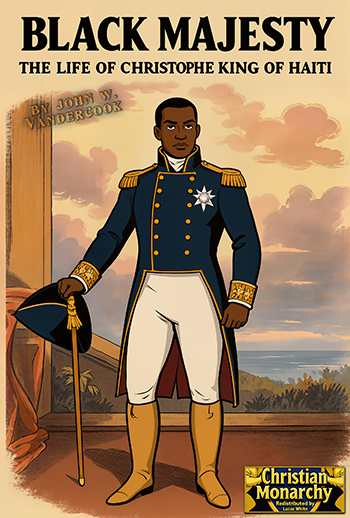

When Christophe declared war on Napoleon, burned the city of Cap Francois and retired into the hills, he could name few men who were faithful to him. His supplies were what they carried in their hands. But he was armored with a powerful thing. Christophe had discovered scorn.
LeBrun, the messenger General LeClerc had dispatched from his war squadron, had dropped handbills for the townsfolk to read. They proved to be copies of a proclamation by which Bonaparte hoped to make the blacks believe the warships came only to insure their freedom. Christophe knew it for a pinch of dust blown in a sullen dragon's eyes.
"Whatever your origin and your color, you are all free and equal before God and man. . . . Welcome the French and rejoice to see your friends and your brothers from Europe... . Rally around your Captain-General; he brings you peace." Then: "Whoever dares act independently of the Captain-General will be a traitor to his country and the anger of the Republic will devour him as fire eats up dried sugar cane!"
Napoleon had gestured crudely.
An eternal, drowsy quiet pervades the mountains and the rich green valleys of Haiti. It is unsuited as a scene for war. The screams of wounded men and the roar of bronze cannon melt into echoes that dim away into silence as quickly as does the tinkle of a cowbell or the song of a negro laborer at work in the furrows of a slanting field.
Christophe, Dessalines, and Toussaint found it hard to realize that they were again at war. After the burning of the Cap, Christophe had retired to a sheltered valley thirty miles back from the sea. Dessalines was encamped in the arid plains behind Saint Marc, a port on the western coast of the island. L'Ouverture was moving with the swiftness of which he was a master across the mountainous mid-section of the colony. Couriers who knew the shortest routes through the maze of hills kept them in communication—but they carried tidings that Saint Domingue was displaying no taste for resistance. The "cultivators," slaves whom the events of the past decade had turned into peasant farmers, were out of sympathy with the generals. Under Toussaint's rule the soldiers had been the privileged class. If the soldiers wanted to put their heads into the lion's mouth of an infuriated France, let them fight their own battles. The whites, too, were cordial to the French. And the mulattoes, the former freedmen, were more friendly to LeClerc than any of the rest. They had always been free. . . . Therefore the leaders and their soldiers were alone. Even the generals were defying France for different reasons, Dessalines, born in the jungles of Africa and transported as a slave, had a store of memories to draw on. Toussaint fought for fear and pride. He loved France and her traditions, but he loved his weary, dull-eyed people far more. He feared with a kind of frenzy that slavery would begin again. And the old man had drunk of power. If only the young conqueror had seen fit to show him some slight homage, if only Napoleon had troubled to answer so much as a single one of the letters he had written telling of the conquests he had won for France—then he might have trusted him. Henry Christophe fought for a triple cause. In a measure, he shared the hatred of Dessalines, more fully he agreed with Toussaint, but primarily he despised Napoleon. For a decade he had heard stories of the marvelous little artilleryman who had vanquished so many armies. Then the squadron came to rest outside the bay of Cap Francois and Napoleon stood revealed through messages signed with his own hand as a petty cheat devoid of justice and even the pride young Henry thought fitting in a fighting man.
No time was wasted. LeClerc, furiously angered by the burning of Cap Francois, resolved to hasten the routing of the blacks.
A large detachment dispatched to "arrest" Christophe was effectively checked, and won only the ashes of another town.
In the west, Dessalines, confronted with a superior force, fought valiantly though briefly, and retreated, burning everything in his line of march—towns, fields, estates and mills.
LeClere hastened to follow the instructions of Bonaparte.
Abbé Coisnon, the tutor under whom Toussaint's sons had studied in Paris, went with them to a country farm where Madame Toussaint awaited her husband. L'Ouverture did not come at once, so Coisnon had an opportunity to pour into her ears his tale of Napoleon's devotion to the negro cause. When the old man arrived, Coisnon, his sons, and his wife urged him to surrender. They told him he was mistaken in looking upon France as an enemy.
Toussaint listened, torn by indecision. He sank into a chair in the parlor of his little house. Beneath the scheming eyes of Coisnon he ceased to be the conqueror and governor and sobbed like a tired old man agonized by loves that twisted him. He knew that if he kept faith to his people, his sons must go back to LeClerc, perhaps to pay forfeit with their lives. And perhaps the freedom of the blacks was not at stake. Then his sacrifice would be vain. How cruel if lives were lost to balm the hurt pride and the foolish fears of an old black slave.
He retired into an adjoining room to compose himself and reach a decision. After a little he came out, master of himself.
A number of his officers and several members of his family were awaiting him. He shook his head. He would prepare a letter to LeClerc explaining his stand.
He withdrew again and while the others slept he wrote all night. In the morning Coisnon returned to the Cap with Toussaint's sons.
LeClerc, chagrined, declared Toussaint and Christophe "outside the law."
The war went on. It had been thundering in a dozen places while Coisnon urged Toussaint to take credence in Napoleon's pacific aims.
The French, in the month that followed, never lost a victory, but they lost men, morale, and temper. The white troops were disturbed and uncertain. They were good Republicans whose lives for the past decade had been devoted to the cause of liberty. It troubled them that when they marched to meet the negroes in battle their antagonists sang La Marseillaise. Sometimes the opposing lines would sing in unison, audible and strange above the cannon and the cries of the dying.
Every day the negro generals lost nearly as many soldiers by desertion as through the natural casualties of war. The coolness of the peasant class changed gradually into active enmity. Many joined LeClerc's battalions.
But the hills were doing their part. The angry young Captain-General wrote to the Minister of Marine in Paris:
It is absolutely necessary to see the country to form an adequate idea of the difficulties which it presents at every step. I have never seen in the Alps any obstacles equal to those with which it abounds!
The blacks showed no symptoms of discouragement.
Dessalines summed up their mood: "Take courage, I tell you," he boomed at his ragged troops one roasting afternoon when the French had them besieged apparently beyond hope of escape in a little fortress in the foothills of the west. "The French cannot resist us long. Soon sickness will overtake them and they will die like flies. Hearken! If Dessalines surrenders a hundred times it will be to betray them a hundred times. I repeat, take courage! And you will see that when the numbers of the French have shrunk, they will not be able to guard the country ... for we will always take refuge in our impregnable hills. They will be forced to quit it. Then I will give you independence."
Pauline was in Cap Francois. The people of the ravished town had built her a terraced palace on a promontory overlooking the wide bay. It had risen, a crude copy of perfection, almost overnight. There, surrounded by her entertainers, her Paris servants, and her ladies and gentlemen, she waited and wondered. She could not understand why their charming plans had gone so wrong. They had come, she thought, to govern a colony, to rest awhile beneath the tropic sun. And after two whole months her husband was still busy with a foolish war against some ugly blacks. What was the matter? Hadn't it all been arranged by her clever brother before ever they set sail? It was hard LeClerc found no time for her... . The days were fearfully dull. The frightened people picking despairingly among the débris of their ruined city were hardly a cheering sight to watch from a mullioned palace window.
Then a letter came. Pauline's pale, pretty face lighted with the first smile it had worn in weeks.
LeClerc had routed the rebels. To be frank, they had all escaped—by the extraordinary expedient of walking under cover of night straight through the French lines. But no matter. LeClerc felt safe in throwing overboard the childish protestations by which he had sought to trick them. He declared the plantation lands restored to their rightful owners and added that slavery was to be returned at once to its old footing.
This was better news to send Bonaparte than tales of fruitless hill climbs.
The order proved premature. Tens of thousands of peasants joined General Christophe. With a vast avenging horde of half-naked people of the farms and hills, armed only with billhooks and hoes, Christophe swept across the north. News reached LeClerc that the negro camp fires were visible to the soldiers and civilians crowded amid the ruins of Cap Francois.
The Captain-General was stationed at Port au Prince when the news came. It is a long voyage from the Port to Cap Francois. It was quadruply long for the young general. He was pale, frightened, homesick for France and hungry for Pauline. As he walked the decks of his flagship he pulled at his burnsides till his long serious face turned from white to scarlet.
But Cap Francois was saved, for LeClerc and his fleet arrived in time.
He hastened to issue another proclamation. There had apparently, he announced, been a misunderstanding. The thing that lay nearest the heart of every Frenchman was freedom. He declared the freedom of the blacks in Saint Domingue would never be questioned, "Subject, of course, to the approval of my superiors in France."
Christophe, haggard from privation and the endless marching, was mending the army so sadly broken by his victories. When he heard the news his eyes narrowed.
A few days later he received a letter from a mulatto named Vilton, a man who had been his comrade in the army of L'Ouverture. Vilton was now a faithful officer of LeClerc's.
My dear friend \[he wrote\], with mortal regret have I watched your refusal to submit to the French general whom the First Consul has sent to maintain the order which you so successfully established in the city of the Cap and in the region of the north. . . . You have sacrificed both happiness and fortune. . . . Everyone, especially your friends, believes you have had bad counsel and have been ruled by the black chiefs who surround you. ... M. LeClerc is so persuaded that it was bad advice that caused you to resist him that he is quite ready to pardon you if you care to bring under his authority the troops which you command and the position you hold. . . . We can guarantee you a fortune and the peaceable enjoyment of it under the protection of France in whatever country you choose. . . . Quit your vagabond existence and abandon the cause of an ambition which can come to nothing!
A sub-officer read the letter to Christophe. He went apart from the clearing in the mountain forest where his troops were bivouacked. The great cockade hat on his head was shapeless from many rains. The rich blue dye of his gold-braided coat was faded from the fierceness of the sun. His knee-boots were so torn his feet were almost bare. He looked to where the men of his following crouched in whispering groups around the cook fires. They now numbered less than three hundred. Among them they could not have collected perfect equipment for a single soldier. They did not complain, but against the legions of the French, swelled every day by fresh re-enforcements from Europe, they had nothing to oppose but their passion, their contempt, and their sweating, stalwart bodies.
Christophe strode to an eminence in mid-clearing. He flung out his hands, stiff-fingered, tense. All Saint Domingue had learned to watch those hands. In the consciousness of his people they had become the symbols of his strength. The brown faces stared at him, dog-like. The hands relaxed.
"Comrades," he said, "it is useless any longer to fight the battles of our brothers on the field of war. The cultivators everywhere are returning to their farms. I will defend our cause henceforth in the councils of the colony. The French, though they outnumber us a regiment to a man, have learned to fear us. I will make a peace that will do us honor. . . . But whatever comes, remember that these hills are ours, that they will wait for us!"
That night Christophe dictated his answer to Vilton:
I am ready to retract. But my doubts must be removed, my suspicions cleared up. There is no sacrifice that I will not make for the peace and happiness of my fellow-citizens if I am but convinced they will all be free and happy. Produce the proofs necessary for my conviction.
You speak to me of fortune. I no longer have any. Honor is the only possession now left me and my family. In friendship,
H. Christophe.